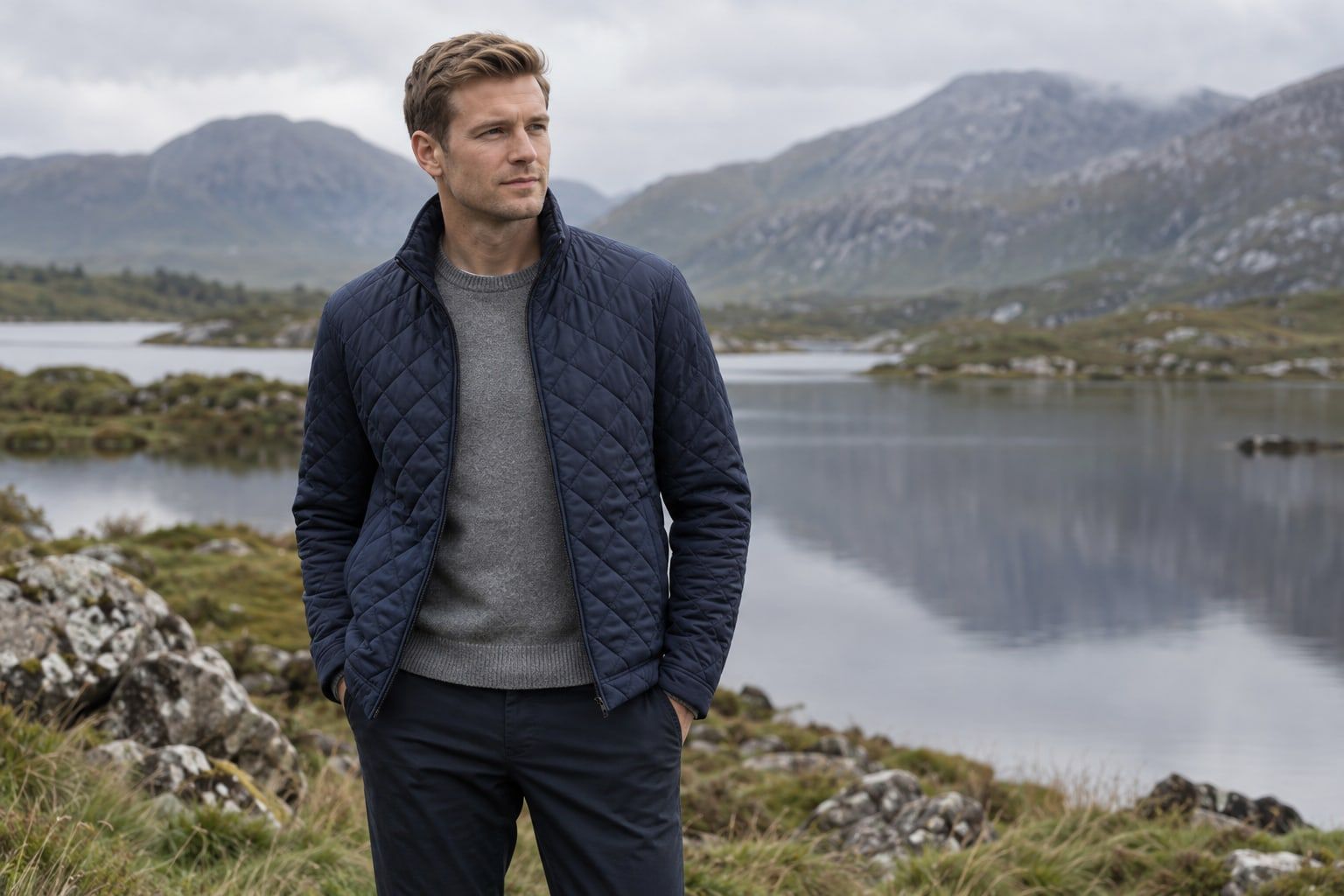
Buying guide · Fit
How to Choose a Jacket That Fits Properly

A jacket that fits well looks better, keeps you warmer and lasts longer, because nothing is straining at the seams. The good news is that fit comes down to a handful of checks, done in the right order. Get the shoulders right first, then the chest, the sleeves and the length, and finally make sure you can move.
This guide is the overview. Each step links to a more detailed fit guide if you want to go further.
Before you start: know your numbers
You don't need a tailor, just a soft tape measure and someone to help. Your chest, shoulder width and arm length are the three measurements that matter most for jackets, and they let you read a brand's size chart properly instead of guessing. Our guide on how to measure yourself for a jacket walks through each one.
Then remember that sizes are not standard. A medium from one brand can be a small or a large from another, and European outdoor brands often cut slimmer than US brands. Always check the brand's own chart, and read why jacket sizes differ between brands before you assume your usual size.
1. Shoulders first
The shoulders are where fit starts, because they are the hardest and most expensive part of a jacket to alter. Sleeves can be shortened and a waist can be taken in, but a jacket that's wrong at the shoulders will always look wrong.
On a tailored jacket or coat, the shoulder seam should sit roughly where your shoulder bone ends. If it sits inside that point, the jacket is too small: you'll see pulling across the upper back and the sleeves will bite into your arms. If it hangs down over the top of your arm, the jacket is too big, and the whole thing will look borrowed.
Casual and outdoor jackets are more forgiving. Many rain shells and puffers use raglan sleeves or dropped shoulders, with no seam at the shoulder point at all, so look instead for a smooth line from neck to arm with no pulling or dents. Our guide to how a jacket should fit at the shoulders, chest and waist covers both styles in detail.
2. Chest and closure
Close the jacket fully, zip or buttons, and stand naturally in front of a mirror.
- Too tight: buttons pull and the fabric forms an X-shaped crease around them, or a zip strains and won't lie flat.
- About right: the front lies flat, with a little room. You should be able to slide a flat hand inside the closed jacket without it pulling.
- Too loose: the front billows or sags when buttoned, and the fabric folds into vertical ripples.
Check it with your arms down and again with them crossed in front of you. A jacket that only closes when you stand perfectly still is a size too small, especially for a coat you'll be wearing over jumpers from October to March.
3. Sleeve length
Sleeves are the most common fit problem, and the easiest to spot.
For a tailored coat, with your arms hanging naturally, the sleeve should end around your wrist bone, leaving room for a shirt cuff to show a little underneath. For rain jackets and outdoor shells, a slightly longer sleeve is better: it should still cover your wrist when you reach forward, and the adjustable cuff should close over the top of a glove. For puffers, the sleeve should reach the base of your thumb, since insulation bunches up as you bend your arm.
If the sleeves are long but everything else fits, that's usually fixable. If they're short, it usually isn't. More on this in are your jacket sleeves too long or too short.
4. Body length by jacket type
Length depends on what the jacket is for, and it changes how warm and dry you'll stay.
| Jacket type | Typical length | Why |
|---|---|---|
| Bomber, harrington, denim | At the waist or belt | Neat and casual, but leaves your lower back exposed |
| Rain jacket | Covers the seat | Stops rain running onto your trousers |
| Puffer | Hip to mid-thigh | Longer is warmer; shorter is easier to move in |
| Overcoat or trench | Above or below the knee | Covers a suit jacket and keeps your legs drier |
If you cycle, make sure the back is long enough to cover your lower back when you lean over the handlebars. If you drive a lot, a very long coat can bunch uncomfortably in the seat, and a hip or thigh-length jacket may be more practical day to day.
5. Room for layering
This is where Irish buyers most often go wrong. People try on a winter coat in a warm shop wearing a T-shirt, then find in December that it won't close over a chunky jumper.
Think about what you'll really wear underneath. A rain shell for spring and summer may only cover a T-shirt or a light fleece. A shell you'll use all year needs room for a fleece or a thin insulated layer. A winter coat should go comfortably over your heaviest jumper or a suit jacket. Bring that layer with you when you try it on.
Our guide on how much room to leave for layering has more detail by jacket type, and slim vs regular vs relaxed fit explains how the cut affects how much space you'll have.
6. Movement tests
A jacket can look perfect in a mirror and still be wrong the moment you move. Do these five checks in the changing room or at home before the tags come off.
- Reach forward, as if for a door handle or a handlebar. The sleeves shouldn't ride halfway up your forearm, and the back shouldn't feel tight across your shoulder blades.
- Arms up over your head. The hem shouldn't lift much above your waist, and on a rain jacket your wrists should stay covered. This is the test that matters most when you're reaching for a bus rail or a top shelf.
- Hug yourself, crossing your arms over your chest. If the seams across your back feel like they might give, the jacket is too tight through the shoulders or upper back.
- Sit down. Long coats and parkas should still close comfortably over your lap, without the front pulling open or the collar riding up around your neck.
- Turn the steering wheel. Sit and hold your arms out as if driving, then turn. If the sleeves pull back hard or the collar digs in, you'll notice it every day on the school run.
Fit for different jacket types
The checks are the same, but the target is different for each kind of jacket.
Tailored overcoat
This is the most precise fit. The shoulders should sit cleanly at your shoulder bone, the coat should close over a suit jacket or jumper without pulling, and the sleeves should end just past your wrist. A good overcoat should look tidy, not tight. Shortening sleeves and adjusting the waist are straightforward alterations, but a tailor can rarely fix shoulders.
Rain shell
A rain shell needs room to move and to layer underneath, so it should feel a little looser than everyday clothing. Look for sleeves that still cover your wrists when you reach up, a hood that turns with your head when it's cinched down, and a hem that covers your seat. Too tight and the fabric presses against you, which makes you feel damp and clammy even when the jacket isn't leaking. See how to choose a waterproof jacket for the features to check.
Puffer
Insulation only works when it can loft, so a puffer shouldn't be stretched tight across your chest or back. If the baffles look flattened when you zip it up, size up. Equally, a puffer that's too big lets warm air escape at the hem and cuffs. A snug but not tight fit, with room for a light jumper underneath, is usually right.
Buying online and returns
Buying online makes fit harder, because you can't try before you pay. A few habits make it much easier.
- Measure a jacket you already like. Lay it flat and measure across the chest from armpit to armpit, the back length and the sleeve. Compare those numbers with the brand's garment measurements, not just the body chart.
- Read the fit description. Words like "athletic", "regular" or "relaxed" tell you how much ease the brand has built in. Reviews that mention running large or small are useful too, as long as several people say the same thing.
- Try it on with the layers you'll wear. Do the movement tests at home, in front of a mirror, with the jumper or fleece you'll actually wear.
- Keep the tags on. Try it indoors on a clean floor, and don't wear it outside until you're sure. Most retailers won't accept returns of worn or damaged items.
- Check the return policy before you buy. Under EU consumer rules, you generally have 14 days to cancel most online purchases from EU-based sellers, but return shipping costs and conditions vary. Sellers outside the EU may have different terms and can add customs charges.
If you're between sizes, ordering two and returning one can save a lot of guesswork, as long as returns are free or cheap. Before you do, read common jacket sizing mistakes, which covers the habits that most often lead to a second order.
When to get it altered
Some fit issues are worth fixing, others aren't. Sleeve length on a wool coat, a slightly loose waist and a hem that's a little long are all routine alterations. Shoulders that are too narrow or too wide, a jacket that's tight across the back, and anything on a waterproof jacket (where new stitching would break the seam tape) are best avoided. If the shoulders and chest fit, almost everything else can be sorted. If they don't, choose a different size or a different jacket.