Weather

Jackets
Waterproof Jackets
In Ireland a good waterproof is the jacket you'll reach for most. The trick is matching the level of protection and breathability to how you actually spend time in the rain.
What to look for
- 01
Fully taped seams
Every stitched seam should be sealed with tape on the inside, otherwise water creeps through the needle holes in steady rain.
- 02
A hood with a stiffened peak
A peak with some structure keeps rain off your face and glasses, and a rear adjuster stops the hood blowing back in wind.
- 03
Ways to vent heat
Pit zips, a two-way front zip or mesh-lined pockets let warm air out when you're walking fast or climbing a hill.
- 04
Adjustable cuffs and hem
Velcro or elastic cuffs and a hem drawcord seal out wind-driven rain, which is the kind Ireland specialises in.
Waterproof vs water-resistant
This is the most important distinction in the category, and the labels are often used loosely.
A waterproof jacket has a membrane or coating that stops water passing through the fabric, plus sealed seams so water can't get in at the stitching. It should keep you dry in steady rain for hours.
A water-resistant or showerproof jacket has a tightly woven fabric and usually a water-repellent finish that makes rain bead up and roll off. It copes with a passing shower or a drizzly walk to the shop, but in steady rain the fabric eventually soaks through, and stitched seams let water in sooner.
| Type | Copes with | Best for |
|---|---|---|
| Water-resistant | Light showers, drizzle | Town, short walks, dry-ish days |
| Waterproof, everyday | Regular rain | Commuting, school run, dog walks |
| Waterproof, technical | Heavy, sustained rain and wind | Hillwalking, long days outside |
In Ireland, where Met Éireann figures put rain on roughly 150 days a year in the east and up to 225 in the west, a water-resistant jacket is a useful extra but rarely enough on its own.
The main types of waterproof jacket
Everyday rain jackets
Clean-looking jackets designed for town, often slightly longer to cover the hips. They usually use 2-layer or 2.5-layer fabrics, which keep the price and weight down while handling a wet commute well.
Waterproof parkas and longer coats
Thigh-length or longer, often with a light lining or insulation. They suit anyone who spends time standing still in the rain: on the sideline, at the school gate or waiting for a Luas.
Technical shells
Lighter, more breathable and more protective, typically 3-layer construction with helmet-compatible or wired hoods. Built for hillwalking and active use. See outdoor jackets for more on these.
Packable shells
Very light waterproofs that fold into a pocket or their own stuff sack. Handy for travel and summer, though thinner fabrics are less durable. See lightweight jackets.
Who it suits and when in the Irish year
Almost everyone in Ireland benefits from a waterproof, year round. In winter, wear it over a fleece or light insulated layer, which is often more flexible than a single heavy coat; our guide to how much room to leave for layering helps you size for that. In summer, a thin shell lives in the bag or the car for the inevitable shower.
West coast walkers and cyclists face more wind-driven rain than people in the east, so they get more value from a stronger hood, better cuffs and higher waterproof ratings.
The key decisions
How active you'll be. The harder you work, the more breathability matters. A walk to the bus barely tests a jacket. Cycling to work or climbing in Kerry does. Breathability is measured as MVTR (higher is better) or RET (lower is better, under 6 is very breathable), though not every brand publishes figures.
Length and cut. Shorter jackets suit cycling and hillwalking. Longer ones keep your legs drier when walking in town.
Hood design. For daily use, a hood that rolls away into the collar keeps things tidy. For the hills, a larger adjustable hood matters more.
Our full guide on how to choose a waterproof jacket goes deeper on ratings, fabrics and features.
Common mistakes
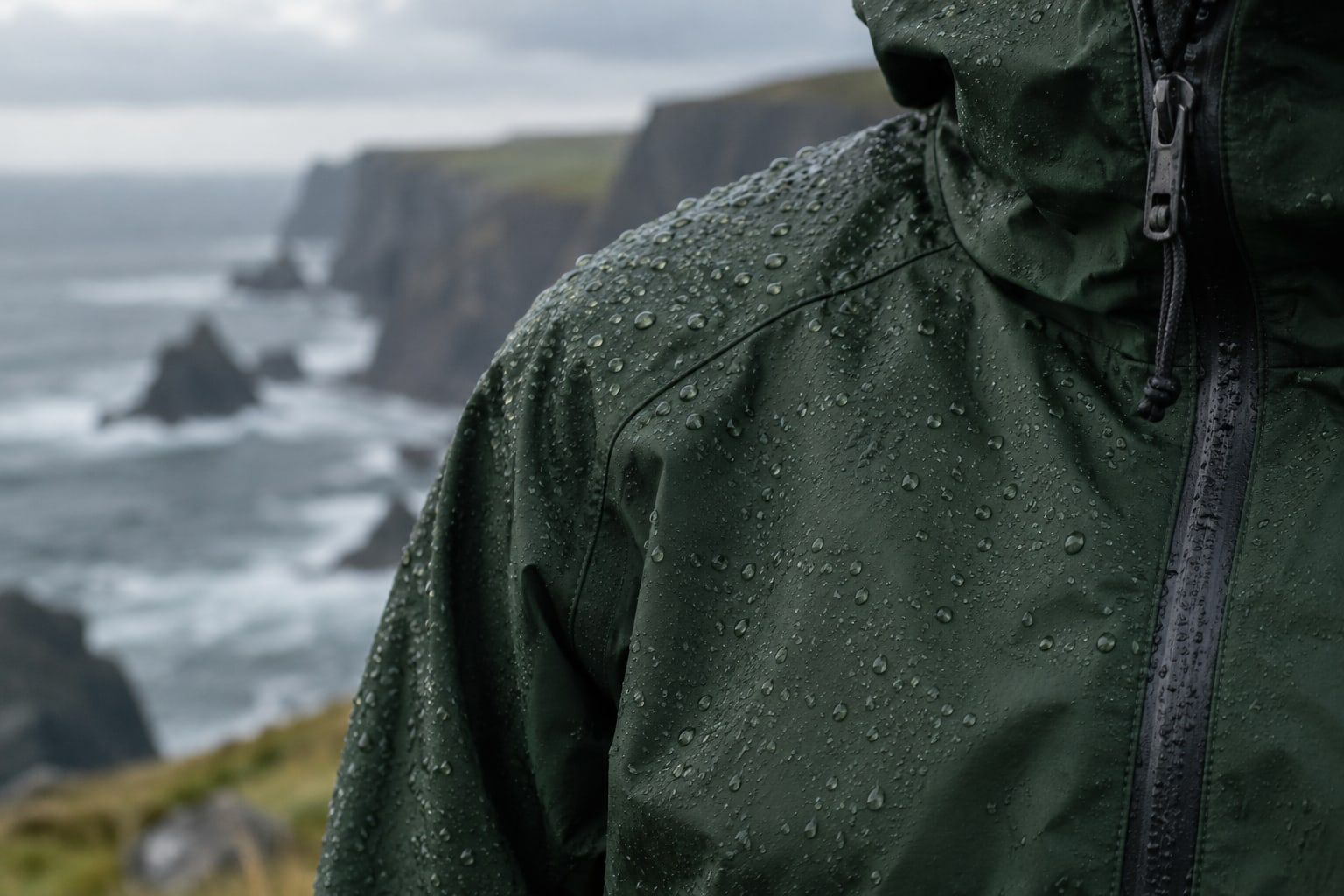
Never reproofing. When the outer fabric stops beading and starts darkening in rain, the water-repellent finish has worn off. The jacket still blocks water, but it feels clammy and less breathable. Wash it with a technical cleaner and reproof it once or twice a year.
Washing with ordinary detergent and softener. Both can clog the membrane and strip the finish. Use a cleaner made for waterproofs.
Buying too snug. A waterproof sized for a T-shirt won't go over a fleece in January.
Guides for waterproof jackets

Getting the fit right
Questions people ask
How waterproof does my jacket need to be for Ireland?
As a rough rule of thumb, around 10,000mm hydrostatic head handles regular rain for everyday use, while 20,000mm or more suits long days out in heavy, sustained rain. For short walks between car, shop and office, a lower rating is usually fine. Seam taping and a good hood matter just as much as the number.
Why does my waterproof jacket feel wet inside?
Usually it's condensation rather than a leak. When you're working hard, sweat vapour can't escape fast enough, especially once the outer fabric has wetted out and stopped repelling water. Opening vents, wearing a breathable base layer and refreshing the water-repellent finish all help.
How do I dry a waterproof jacket without a tumble dryer?
Hang it on a hanger away from direct heat, with the zips open and the hood down so air can circulate. Avoid draping it over a hot radiator, which can damage the membrane and seam tape over time. A low tumble dry can help reactivate the water-repellent finish if the care label allows it, but it isn't essential.
Do I need Gore-Tex?
Not necessarily. Membranes such as Gore-Tex and eVent are well proven, but many jackets use their own membranes or coatings that work well for everyday use. The construction, seam sealing and fit matter as much as the name on the label.