Buying guide · Warmth
Down vs Synthetic Jackets
The short answer: in Ireland, synthetic insulation suits more people more of the time, because our cold is usually wet cold. Down is the better material on paper, warmer for its weight and far more packable, but it needs to be kept dry to deliver on that promise. The right choice depends less on which is "better" and more on where, and in what weather, you'll actually wear the jacket.
How each one keeps you warm
Neither down nor synthetic fill produces heat. Both work by trapping still air close to your body, and still air is a very good insulator. The more air a material can hold for its weight, and the better it holds it in awkward conditions, the warmer the jacket.
Down
Down is the soft under-plumage of ducks and geese, not the feathers you see on the outside of the bird. Each cluster is a three-dimensional puff of fine filaments that springs open and traps a remarkable amount of air. That is why a good down jacket can feel almost weightless yet keep you warm on a frosty morning.
Synthetic
Synthetic insulation is made from fine polyester fibres engineered to imitate that lofty structure. It traps air too, just less efficiently for its weight. What it gives up in warmth for weight, it makes back in tolerance for moisture, compression and rough handling.
Down: fill power, fill weight and ratios
Three numbers appear on most down jackets, and they tell you different things.
Fill power
Fill power measures loft: how much space a fixed amount of down fills when it is allowed to expand. As a rough guide, 550 to 650 fill power is decent everyday down, 700 to 800 is high quality, and 850 to 900+ is premium down used in lightweight technical pieces. Higher fill power means the same warmth from less down, so the jacket is lighter and packs smaller.
Fill weight
Fill weight is how much down is actually in the jacket, usually in grams. This is the number people overlook. A jacket with 300g of 650 fill power down will often be warmer than one with 100g of 850 fill power, because there is simply more insulation in it. Fill power tells you about quality; fill weight tells you about quantity. You need both to judge warmth, and many brands only advertise the first.
Down to feather ratio
Labels such as 90/10 or 80/20 give the proportion of down clusters to small feathers. Higher down content means more loft and less weight. Feathers add a bit of structure and cost less, so cheaper jackets tend to use more of them. If you can feel quills poking through the fabric, that's feather content at work.
Synthetic: the main types
Synthetic fills come under many trade names, such as PrimaLoft, Thinsulate or Climashield, but most belong to two broad families.
Continuous filament
Long, unbroken fibres laid down in sheets. Continuous filament insulation is stable and hard-wearing, holds its structure well after repeated compression and washing, and doesn't shift around inside the jacket. The trade-off is that it tends to be a little stiffer and less packable.
Short staple
Shorter fibres, often blended or clustered to behave more like down. Short staple fills are softer, more compressible and drape more naturally, which is why they turn up in lightweight puffers and insulated mid layers. Some can lose loft a bit sooner with heavy use, and the fill usually needs more stitching to keep it in place.
How synthetic warmth is measured
Synthetic insulation is rated by weight per square metre (g/m²), not fill power. As a rule of thumb, around 40 to 60 g/m² suits a light layering piece, 80 to 100 g/m² a general autumn and winter jacket, and 120 g/m² or more something genuinely warm. Brands often use heavier fill in the body and lighter fill in the sleeves, so check whether the figure applies to the whole jacket.
Warmth for weight and packability
This is where down wins clearly. For the same warmth, a down jacket will be lighter and pack much smaller than a synthetic one. A light down jacket can often squash into its own pocket or a small stuff sack, which matters if you're bringing a warm layer on a Ryanair carry-on or keeping one in a daypack on the Wicklow Way.
Synthetic jackets pack down too, just not as small, and they spring back a little less dramatically. For a jacket that lives in the car or hangs by the door, the difference hardly matters. For travel and backpacking, it can decide the question.
Damp and wet weather: the big Irish question
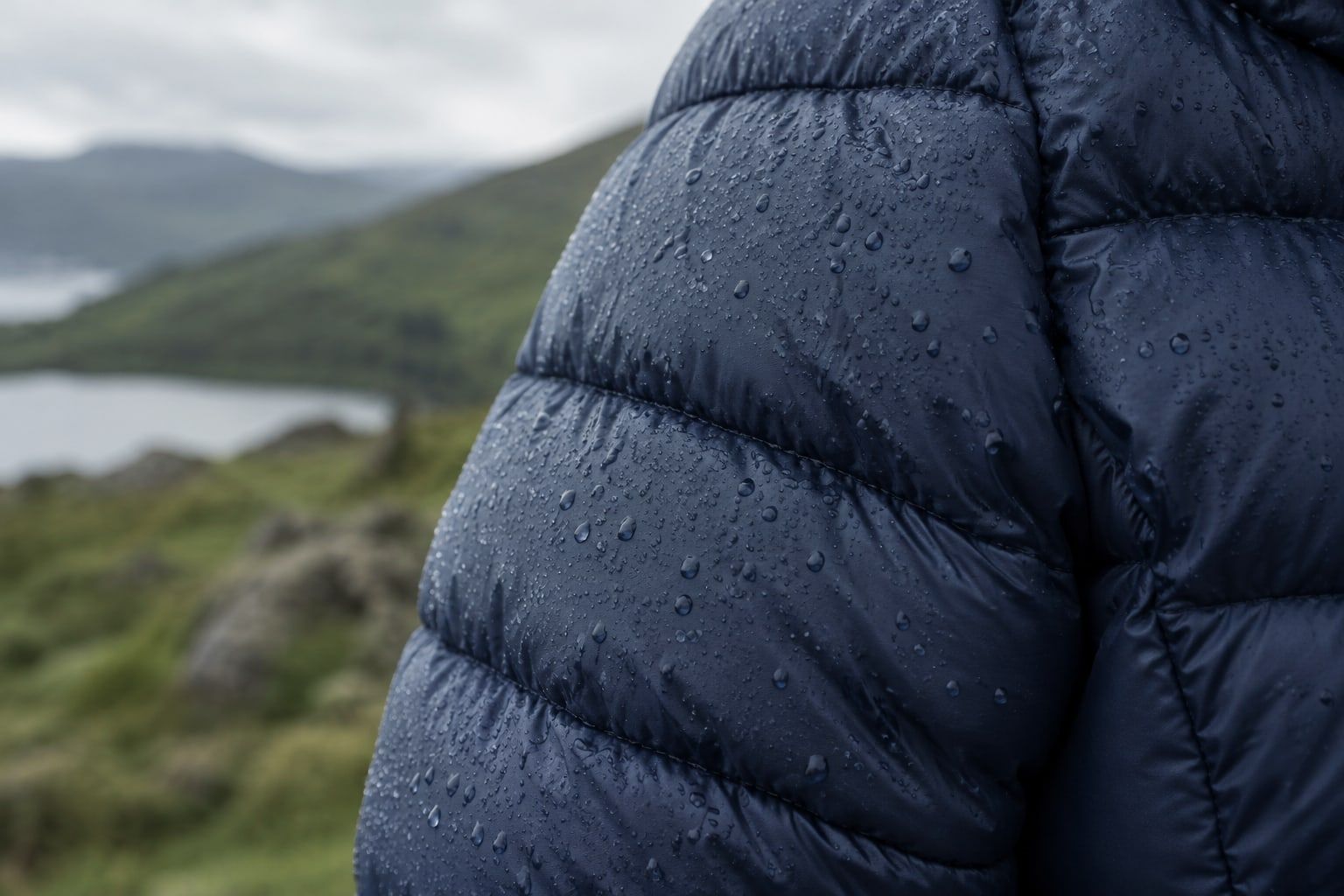
Here's the honest truth about down: when its clusters get wet, they collapse and stop trapping air, and a soaked down jacket offers very little warmth. It also takes a long time to dry. Light drizzle on the outer fabric won't ruin it, since most down jackets have a water-repellent finish, but steady rain, a long walk in a soft day or sweat building up from the inside will slowly flatten it.
Synthetic insulation still loses some warmth when wet, but it keeps much more of its loft and dries far faster. That's why it's the usual choice for insulation that has to work in wet, windy weather.
Remember that Ireland rarely gets very cold. Winter days are often 4 to 8°C and wet rather than freezing, with up to 225 wet days a year in parts of the west. That is close to the worst case for untreated down, and close to the ideal case for synthetic.
Hydrophobic and treated down
Many brands now treat down with a water-resistant coating, sold under various names. Treated down absorbs less water, holds its loft for longer in humid or drizzly conditions and dries faster. It narrows the gap with synthetic, but it doesn't close it. Treated down is still not waterproof, and a heavy downpour will still get through a jacket without a waterproof shell.
Durability and loft over time
Looked after well, good down can last for many years and keeps its loft better than most synthetics over a long life. It recovers well from being compressed, which is part of why quality down jackets hold their value.
Synthetic insulation gradually loses loft every time it is crushed, so a synthetic jacket stuffed into a bag every day for several winters will be noticeably thinner than when new. Continuous filament holds up better than short staple here. On the other hand, synthetic doesn't mind a bit of neglect: it won't clump if stored damp, and it won't leak feathers through a small tear.
Care and washing
Washing down
Down can be washed at home, but it needs care. Use a wash made specifically for down, a gentle cycle at a low temperature, and an extra rinse to get all the soap out. Ordinary detergent strips the natural oils that help down loft.
Drying is the hard part. Down needs a long, low tumble dry with a couple of dryer balls or clean tennis balls to break up the clumps. In a house without a tumble dryer, it can take days of drying flat or on a clothes horse, with regular shaking and teasing apart by hand, and any clumps left damp can start to smell. Many people find it easier to wash at home and finish the drying at a launderette.
Washing synthetic
Synthetic jackets are much more forgiving. Most can go in a normal gentle wash with a mild detergent, and they dry on a radiator-side clothes horse overnight or after a short low tumble. Always check the care label first.
Ethics and sustainability
Down is a by-product of the meat industry, but there have been real welfare concerns about live-plucking and force-feeding in parts of the supply chain. Look for certification such as the Responsible Down Standard (RDS) or the Global Traceable Down Standard, which audit the supply chain for animal welfare. Recycled down, recovered from old duvets and garments, is also increasingly common.
Synthetic insulation is made from petroleum-based polyester, though many fills now use a high proportion of recycled content, often from plastic bottles. Synthetic jackets also shed microfibres when washed, as most polyester clothing does. Neither option is impact-free. A well-made jacket you wear for many winters is usually the more sustainable choice, whichever fill is inside.
Price
At similar quality levels, down jackets usually cost more. High fill power down is expensive to source, and certified or treated down adds more again. Synthetic jackets tend to be better value at the lower and middle of the market, and a decent synthetic will often outperform a cheap down jacket with high feather content. At the top end, both can be expensive; the extra cost of premium down buys you lightness and packability rather than more warmth in wet weather.
Side by side
| Factor | Down | Synthetic |
|---|---|---|
| Warmth for weight | Excellent | Good |
| Packability | Excellent | Good |
| Warmth when damp | Poor (better if treated) | Good |
| Drying time | Slow | Fast |
| Long-term loft | Very good with care | Fair to good |
| Washing | Needs care | Easy |
| Typical price | Higher | Lower to mid |
Which should you choose
City commuting in the rain
Go synthetic. Walking to the bus in Galway or cycling across Dublin in drizzle, a synthetic jacket keeps you warm even when the outer fabric is wet through, and it'll be dry again by the time you go home. If you love the look of a down puffer, choose one with treated down and a water-resistant outer, or wear a waterproof over it on the worst days. Our guide to waterproof jackets explains what to look for in that outer layer.
Dry cold trips abroad
Go down. A city break in a continental winter, a ski trip or a week somewhere with crisp, dry cold is exactly where down shines. You get the most warmth for the least weight, and it packs small enough to fit in cabin luggage.
Hillwalking
For most Irish hillwalking, synthetic is the better bet as an active or stop-and-rest layer. You'll be sweating on the climb and exposed to wind and showers on the ridge, and a synthetic layer copes with both. A light down jacket can still earn a place in your pack as a dry, warm layer for lunch stops on a clear winter day, kept in a dry bag until you need it. See our guide to outdoor jackets for more on the outer layer.
Layering under a shell
Both work well, and this is where down becomes much more practical in Ireland. A thin down or synthetic jacket under a waterproof shell gives you a warm, flexible system: wear the shell alone on mild wet days, the insulated layer alone on cold dry ones, and both together when it's cold and wet. If the shell does its job, the down stays dry. If you sweat a lot or wear the layer for long active days, synthetic is still the safer option. Our winter jacket buying guide covers how to build that system in more detail.
Everyday winter coat
If you want one insulated jacket for the school run, walking the dog and standing on the sideline at a GAA match, a mid-weight synthetic puffer or a treated down jacket with a water-resistant shell is the most practical choice. Browse puffer jackets and winter jackets with that in mind, and check the hood, the cuffs and the length as carefully as the fill.